The Hidden Reality of Traditional PPE Management
In many manufacturing plants, workshops, shipyards, and logistics platforms across Portugal, the daily management of Personal Protective Equipment (PPE) and cutting tools continues to operate under a last-century model: the central warehouse with counter pickup.
While it may seem like a controlled procedure, this model hides three critical inefficiencies that silently drain a company's profitability and legal compliance:
- Unproductive Stoppages at the Start of Each Shift: Dozens of workers head to the warehouse at 08:00 or 16:00 to pick up a new pair of gloves, a mask, or safety glasses. Between travel time, waiting in line, and casual conversation, an average of 15 to 25 minutes per worker per week is lost. In a factory with 80 operators, this equates to more than 1,000 hours of lost production per year.
- Waste and Uncontrolled Consumption: Without parameterized limits per workstation or shift, operators frequently hoard multiple pairs of gloves at their workbenches or take excess consumables "just in case." Industrial sector studies reveal that between 25% and 35% of consumables distributed at an open counter are wasted or misplaced.
- Night Shifts and Weekends Without a Storekeeper: What happens when an operator on the 02:00 night shift tears their cut-resistant glove or breaks their safety glasses, and the warehouse is locked? Either they work without the proper protection—incurring a severe risk of a workplace accident—or they have to halt their workstation until the following morning.
- Legal Vulnerability Before ACT (Law no. 102/2009): When the Authority for Working Conditions (ACT) conducts an inspection, the company is required to formally prove the delivery of each PPE item through individual signatures. In warehouses using manual paperwork and attendance logs, the loss of delivery sheets is common, exposing management to heavy fines.
The technological answer to this challenge is Industrial Vending 4.0: intelligent dispensers and modular lockers installed directly at the heart of production.
1. What Is Industrial PPE Vending?
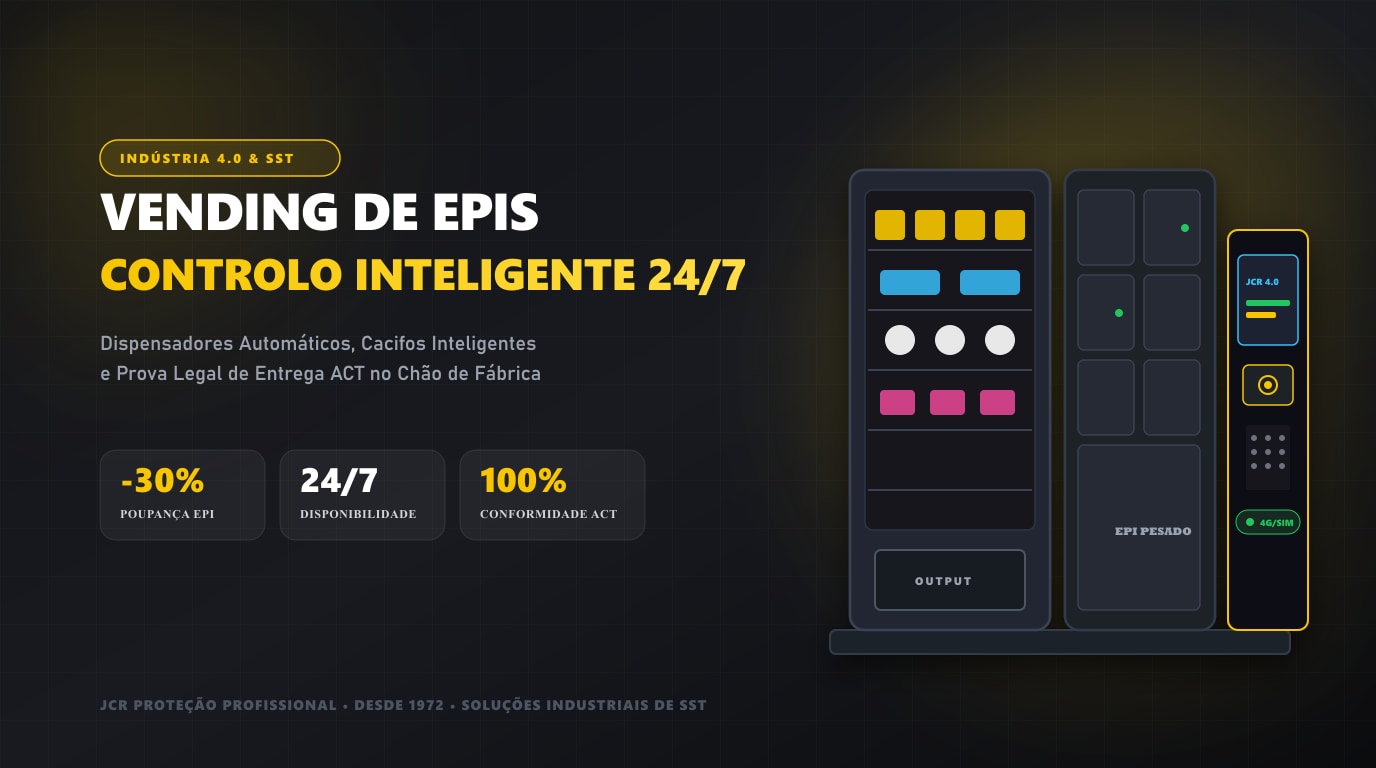
The PPE vending system is an integrated solution combining robust modular hardware and real-time cloud management software, designed to automate the storage, dispensing, logging, and return of protective equipment and technical consumables.
Far from being an adapted soft drink machine, this is a heavy-duty industrial equipment unit that integrates:
- Modular Helix, Coil, and Pusher Dispensers: For high-rotation items with varied geometries (gloves, safety glasses, masks, earplugs, cutting discs, batteries, aerosols).
- Smart Lockers: Configurable modular doors for bulky equipment (safety boots, protective helmets, fall arrest harnesses) and shared power tools.
- Robotic Modules for Workwear: Orderly dispensing of packaged textile items (coveralls, lab coats, t-shirts, disposable gowns) without requiring prior folding.
- Central Terminal with Autonomous 4G/5G Connectivity: Completely independent operation from the factory's IT network, communicating with the cloud without requiring network cabling or complex IT authorizations.
2. How It Works in Practice for the Operator and the Company
The on-site experience is fast, intuitive, and friction-free, completing the delivery cycle in less than 30 seconds:
- Instant Identification (2 seconds): The employee approaches their RFID employee badge (the same one already used for access control or time clocks), enters their numeric PIN, or uses biometric reading.
- Authorization by Workstation and Profile: The system only makes available items authorized for the operator's specific role. A welder will have access to face shields and split-leather gloves; a packaging operator will have access to dexterity gloves and safety utility knives.
- Parameterized Shift Quotas: The company can establish that each worker is entitled to, for example, 2 pairs of gloves per week. Should they need an extraordinary pair, the system requests digital authorization from the supervisor or a reason log (wear and tear, loss, accident).
- Controlled Dispensing with Drop Sensor: The item is dispensed with guaranteed optical sensor verification, with no risk of jamming.
- Digital Signature on the Screen (ACT Legal Value): Directly on the terminal's touchscreen, the worker signs for the receipt of the PPE, immediately generating an unalterable digital receipt in compliance with Law no. 102/2009.
3. The 4 Great Pillars of Benefit
1. Immediate Cost Reduction of 25% to 35%
Experience with industrial clients demonstrates that the mere existence of control and traceability eliminates excessive consumption and loss. Each operator begins to value the provided equipment, increasing the durability of items and drastically reducing the overall volume of annual purchases.
2. Recovery of Productive Working Hours
By installing dispensers near manufacturing islands or section entrances, the average time to obtain a PPE item drops from 15 minutes to less than 30 seconds. In a medium-sized company, this represents tens of thousands of euros in indirect industrial productivity gains.
3. Total Elimination of Stockouts
The cloud software monitors inventory levels in each machine channel in real time. When an item reaches the pre-configured safety stock level, the system triggers an automatic alert to the purchasing manager or directly to the JCR logistics team, which schedules proactive replenishment before stock runs out.
4. Return Cycle (Check-In / Check-Out) in Smart Lockers
For precision power tools, calibration instruments, multi-gas detectors, or safety harnesses, smart lockers make it possible to know exactly:
- Who picked up the equipment and at what time;
- When it was returned and in what condition;
- Automatic alarms triggered if the equipment is not returned at the end of the shift.
4. The Legal Impact: Total Compliance with ACT and Law 102/2009
Article 15 of Law no. 102/2009 and Decree-Law no. 348/93 clearly state: the employer must provide PPE free of charge and documentarily prove that the worker received it.
In the event of a severe workplace accident involving eye injury, for example, if the company only presents purchase invoices for safety glasses but lacks the signed proof that that specific worker picked up the glasses and received instructions for use, the regulatory and criminal liability falls directly on management.
With the intelligent dispenser system:
- Each dispense records the date, time, product code, batch, employee, and workstation;
- The digitized signature is linked to the worker's individual file;
- In the event of an ACT inspection, the delivery report for any operator can be generated and exported to PDF with a single click.
5. Application Cases by Industrial Sector
| Industrial Sector | Typical Vending Items | Main Benefit |
|---|---|---|
| Metalworking & Locksmithing | Cut and impact gloves, safety glasses, abrasive discs, hearing protection, electrodes | End of warehouse queues and a 30% reduction in consumables |
| Glass & Ceramics Industry | High thermal resistance gloves, sleeves, safety footwear, face shields | Continuous 24/7 availability during night shifts and weekends |
| Agro-Food Industry | Disposable coveralls, nitrile gloves, hairnets, robotic hygienic coats | Maximum hygiene without prior human handling and HACCP traceability |
| Logistics & Distribution | Dexterity gloves, safety utility knives, high-visibility vests, flashlights | Strict consumption control in teams of hundreds of operators |
| Chemical & Pharmaceutical | Respirator masks, ABEK filters, chemical gloves, airtight suits | Management of filter expiration dates and blocking PPE for untrained personnel |
6. How JCR Implements the Solution in Your Company
Introducing PPE vending does not require heavy investments in infrastructure or disruptions to your factory operations:
- Prior Audit and Diagnosis: Our technical consulting team visits your facilities, analyzes the PPE purchase history, and identifies critical employee circulation bottlenecks.
- Modular Sizing: We design the ideal composition of spiral/coil dispenser modules, smart lockers, and textile dispensers tailored to your product portfolio.
- Plug & Play Installation: The machines only require a standard 220V electrical outlet. Thanks to the autonomous 4G/5G modem, they become operational within a few hours without intervention from the IT or server department.
- Parameterization & Training: We configure user groups, quotas, and workstations in coordination with Human Resources and the Safety Technician.
- Supply and Programmed Replenishment: As a specialized PPE distributor since 1972, JCR guarantees the continuous supply of certified equipment from the world's best brands, ensuring your machines are always stocked.
Conclusion: The Future of Workplace Protection Has Arrived
The supply of Personal Protective Equipment is no longer a purely bureaucratic warehouse counter task; it has become an agile, intelligent, and fully digitized process.
By adopting industrial PPE vending, your company not only saves up to a third of its annual consumables bill and hundreds of productive hours, but also elevates its safety culture and legal compliance to the highest European standard.
Want to know how much your company can save with intelligent PPE dispensers?
Check out our new PPE Vending Services page and use our return on investment calculator, or directly contact JCR's technical consultants for a no-obligation feasibility study.