Why Footwear Is the Most Critical PPE in a Professional Kitchen
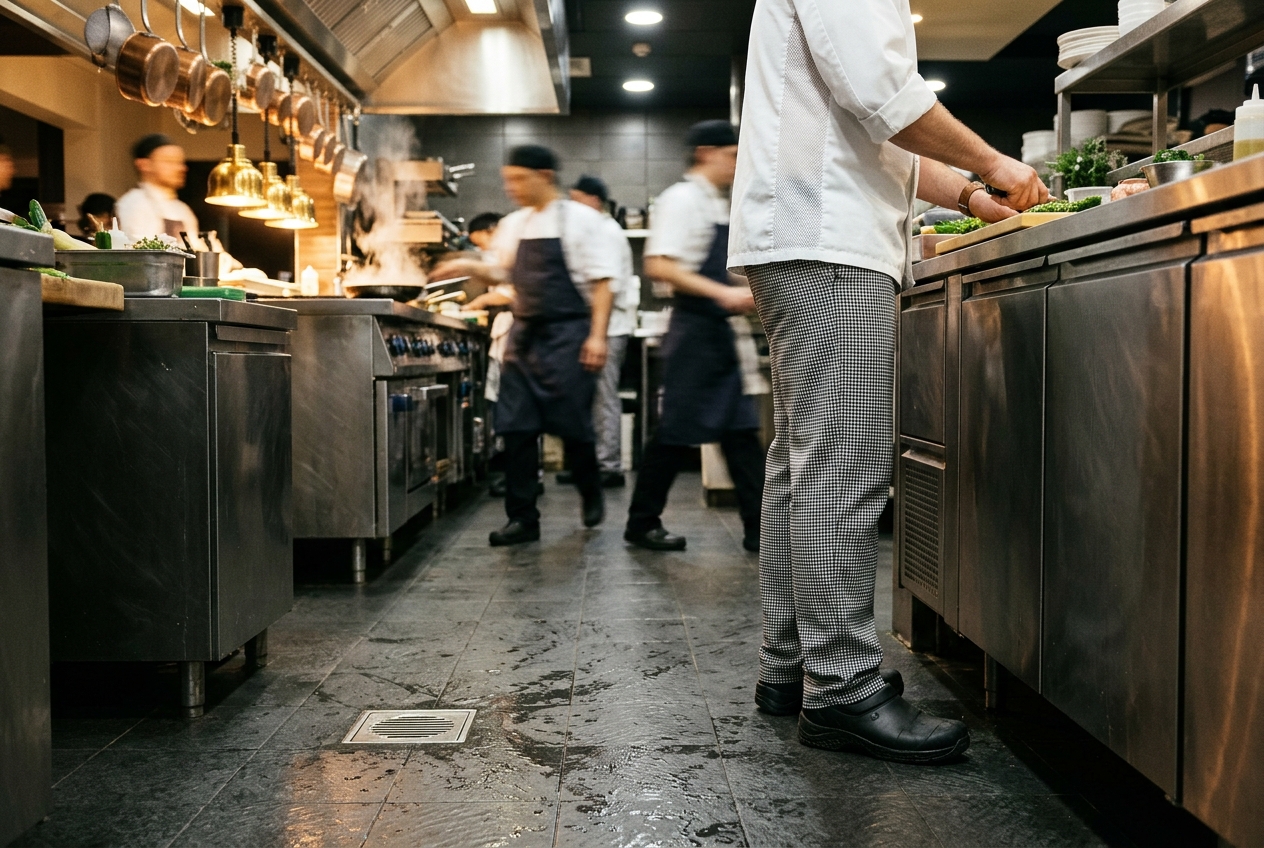
In hotel, restaurant, bakery, and scullery kitchens, the combination of ceramic flooring, water, cooking oils, and a fast-paced environment creates a permanent risk of slips, trips, and falls on the same level. In addition to slips, HORECA professionals frequently spend 8 to 10 hours on their feet, making ergonomics and impact absorption essential.
Choosing standard sneakers or footwear without European certification drastically increases the risk of lower back injuries, sprains, and burns from hot liquid spills.
EN ISO 20347 vs. EN ISO 20345: Which One to Choose?
Before selecting footwear for your team, it is essential to distinguish between the two European standards applicable to the sector:
1. EN ISO 20347 Standard — Occupational Footwear (Without Protective Toe Cap)
Suitable for dining rooms, bars, reception areas, housekeeping, and kitchens where there is no risk of falling heavy objects onto the feet:
- OB: Basic requirements for durability and grip.
- O1: Closed heel, antistatic properties (A), and heel energy absorption (E).
- O2: Adds water penetration and absorption resistance to the upper — highly recommended for kitchens and sculleries with frequent washing and spills.
2. EN ISO 20345 Standard — Safety Footwear (With 200 Joules Toe Cap)
Recommended for large-scale industrial kitchens, storerooms, goods receiving areas, and hotel maintenance, where there is a risk of falling heavy pots, grills, or boxes:
- SB: Basic requirements with a 200J impact-resistant toe cap.
- S2: Includes a protective toe cap, closed heel, antistatic properties, heel energy absorption, and a water-resistant upper — the most sought-after specification in catering and the food industry.
(Complement this reading with our guide on Workwear in the Food Industry and HACCP Standards).
What Does the SR Marking (Slip Resistance) Mean?
With the update to the EN ISO 20345:2022 and EN ISO 20347:2022 standards, slip resistance classification has been simplified:
- The base test on ceramic tile with a detergent solution is now part of the mandatory footwear certification requirements.
- The additional SR marking proves that the sole has also been successfully tested on ceramic tile with glycerin (simulating viscous and greasy kitchen surfaces).
- Models certified under the previous edition (2011) still display the SRC marking (which combined testing on ceramic with detergent and steel with glycerin).
Golden rule: Always check the model's technical datasheet to ensure the slip resistance certification is suitable for your facility's flooring.
4 Practical Criteria for Buying HORECA Footwear
- Closed and washable upper: In the kitchen, prefer smooth technical microfiber or washable clogs without exposed seams that trap food residue.
- Reduced weight and ergonomic insole: Essential for preventing muscle fatigue during double shifts.
- Lace-free (slip-on / loafer / strap-back clog): Easier to sanitize, reduces dirt accumulation points, and prevents tripping.
- Non-marking sole: Especially important for front-of-house, reception, and housekeeping teams in hotels with wooden or marble flooring.
Equip Your Kitchen and Front of House with J C R, Lda.
At J C R, Lda. we provide certified professional clogs, loafers, and shoes from Exena, Velilla, Lavoro, Portwest, and Robusta, backed by technical support to help you select the correct standard for each workstation.
Check out the available selection in Hospitality Workwear and Footwear or contact our technical team (+351 244 111 200 | info@jcr.pt) for personalized advice.