The Mechanical Violence of the Chainsaw and the Importance of Category III PPE
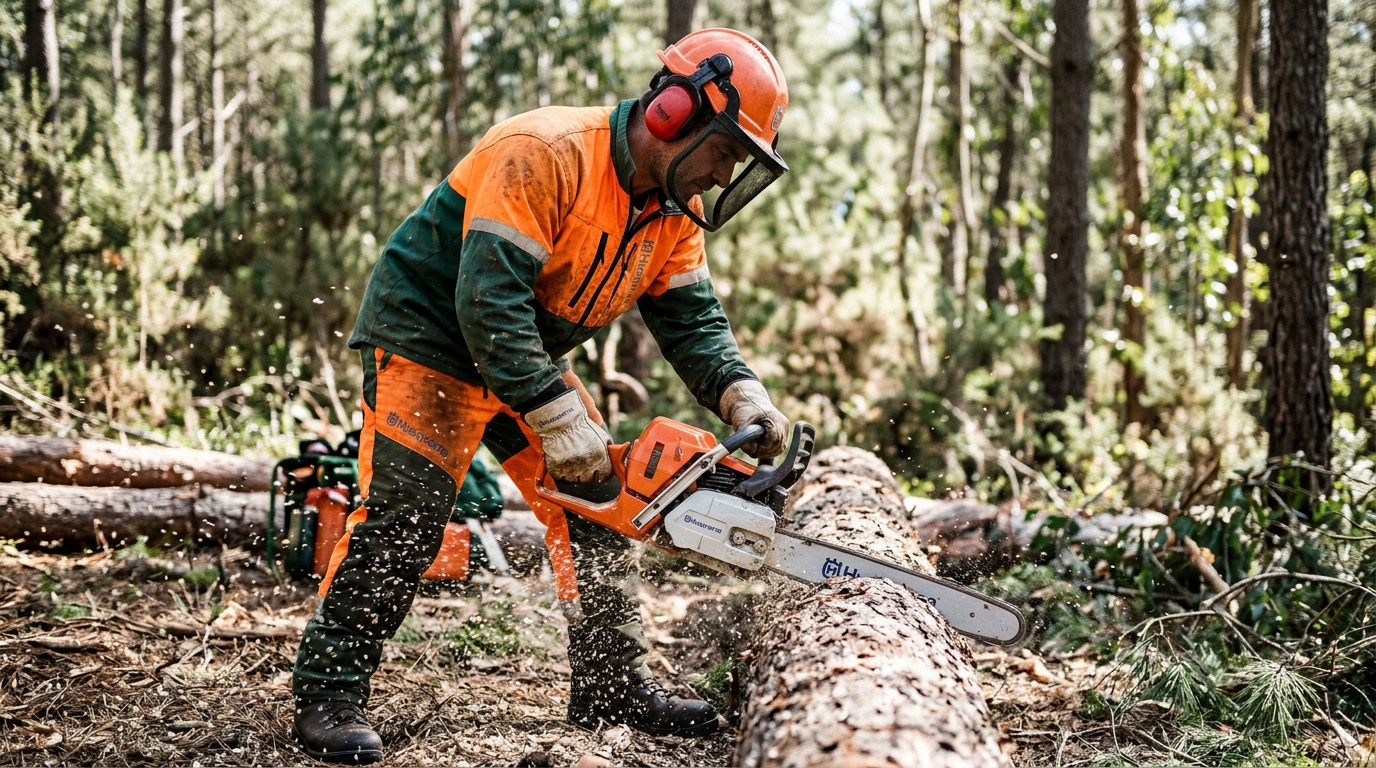
Forestry work — tree felling, limbing, clearing, fuel management strip maintenance, and timber harvesting — is statistically one of the professional activities with the highest rate of severe and fatal accidents in Portugal.
A professional chainsaw chain rotates at speeds between 20 and 28 meters per second (over 100 km/h) and features sharp cutting teeth capable of lacerating biological tissue and bone in a fraction of a second. In the event of kickback or loss of machine control, human reaction time is simply too slow to prevent the chain from contacting the body.
For this reason, personal protective equipment against chainsaw cuts is classified as Category III PPE (Mortal Risk or Irreversible Damage), subject to rigorous ballistic testing under the European standard EN ISO 11393.
1. Chainsaw Cut-Resistant Protective Trousers (EN ISO 11393-2 Standard)
Contrary to popular belief, chainsaw cut-resistant trousers do not use steel plates or rigid plastic (which would restrict the operator's movement). The secret lies in an ingenious physical principle of mechanical jamming:
- Inside the trousers, there are 6 to 9 layers of special synthetic fibers (ultra-high tenacity polyester or high-density polyethylene) arranged in a cross-woven pattern.
- When the chainsaw chain cuts through the outer layer of fabric, the chain teeth instantly pull out thousands of long, resistant fibers.
- These fibers are dragged into the drive sprocket and clutch drum of the chainsaw within milliseconds, mechanically jamming the engine and immobilizing the chain before it reaches the operator's leg.
A. Cutting Speed Classes:
- Class 1: Tested for a chain speed of 20 m/s (the most common for standard forestry work and gardeners).
- Class 2: Tested for a chain speed of 24 m/s (for intensive felling and professional operators using large-displacement chainsaws).
- Class 3: Tested for a chain speed of 28 m/s (for extremely high-risk tasks and specialized cutting).
B. Design A vs. Design C:
- Design A: Protection concentrated on the front of both legs (180º plus 5 cm on the outside of the left leg and inside of the right leg). These are the lightest and most ventilated trousers, recommended for experienced chainsaw operators who always work on the ground.
- Design C: Full 360º protection around the entire circumference of both legs. Mandatory for work at height with a chainsaw, tree pruning, and for occasional or trainee operators.
2. Forestry Safety Boots for Chainsaws (EN ISO 17249 Standard)
A standard S3 industrial safety boot does not protect against the direct impact of a chainsaw. For forestry cutting work, footwear must carry the specific EN ISO 17249 certification.
- High-Resistance Steel Toecap: Withstands impact and crushing from heavy logs.
- Cut-Resistant Protection on the Tongue and Instep: Internal ballistic layer identical to that of the trousers to stop the chain in the event of an inadvertent slip of the guide bar.
- High-Traction Lug Sole: Deep tread resistant to mud, slippery slopes, roots, and wet rock, featuring an anti-perforation midsole resistant to penetration by pine needles and dry branches.
3. Forestry Head Protection Set (Helmet, Visor, and Earmuffs)
Chainsaw operators face three simultaneous head hazards: falling dead branches, continuous projection of wood chips, and the deafening noise of the two-stroke engine (generally above 105 dB).
The integrated forestry set combines:
- Forestry Protective Helmet (EN 397 Standard): In high-visibility colors (fluorescent orange or neon yellow), resistant to vertical impacts and penetration by sharp branches.
- Wire Mesh Visor (EN 1731 Standard): The steel or polyamide mesh prevents wood chips from passing through without fogging up due to heat and breathing (unlike closed polycarbonate visors).
- Attached Earmuffs (EN 352-3 Standard): With a recommended acoustic attenuation SNR between 28 dB and 32 dB, protecting against noise-induced hearing loss without completely cutting off the perception of the team's sound warnings.
4. Anti-Vibration and Forestry Handling Gloves (EN 388 and EN ISO 10819 Standards)
Continuous vibration transmitted by chainsaws to the hands can cause Raynaud's Syndrome (White Finger Syndrome).
- Forestry gloves with viscoelastic absorption pads on the palm (EN ISO 10819 Standard) reduce vibration transmission and vascular risk.
- The left-hand glove (which holds the front handle) must feature chainsaw cut-resistant reinforcement in accordance with EN ISO 11393-4.
Certified Forestry Equipment with Fast Delivery from JCR
J C R, Lda. equips municipal forestry sapper teams, cutting and clearing companies, and gardening professionals with 100% certified material approved under European Union directives.
- 📞 Contact our technical specialists: +351 244 111 200
- 📧 Quote Requests for Teams: webstore@jcr.pt | info@jcr.pt
- 📍 J C R, Lda. — Martingança Gare, Alcobaça