Respirable Crystalline Silica: An Invisible Enemy on the Factory Floor
Respirable Crystalline Silica (RCS), commonly known as quartz dust, is one of the most dangerous carcinogenic and fibrogenic agents present in industrial workplaces in Portugal.
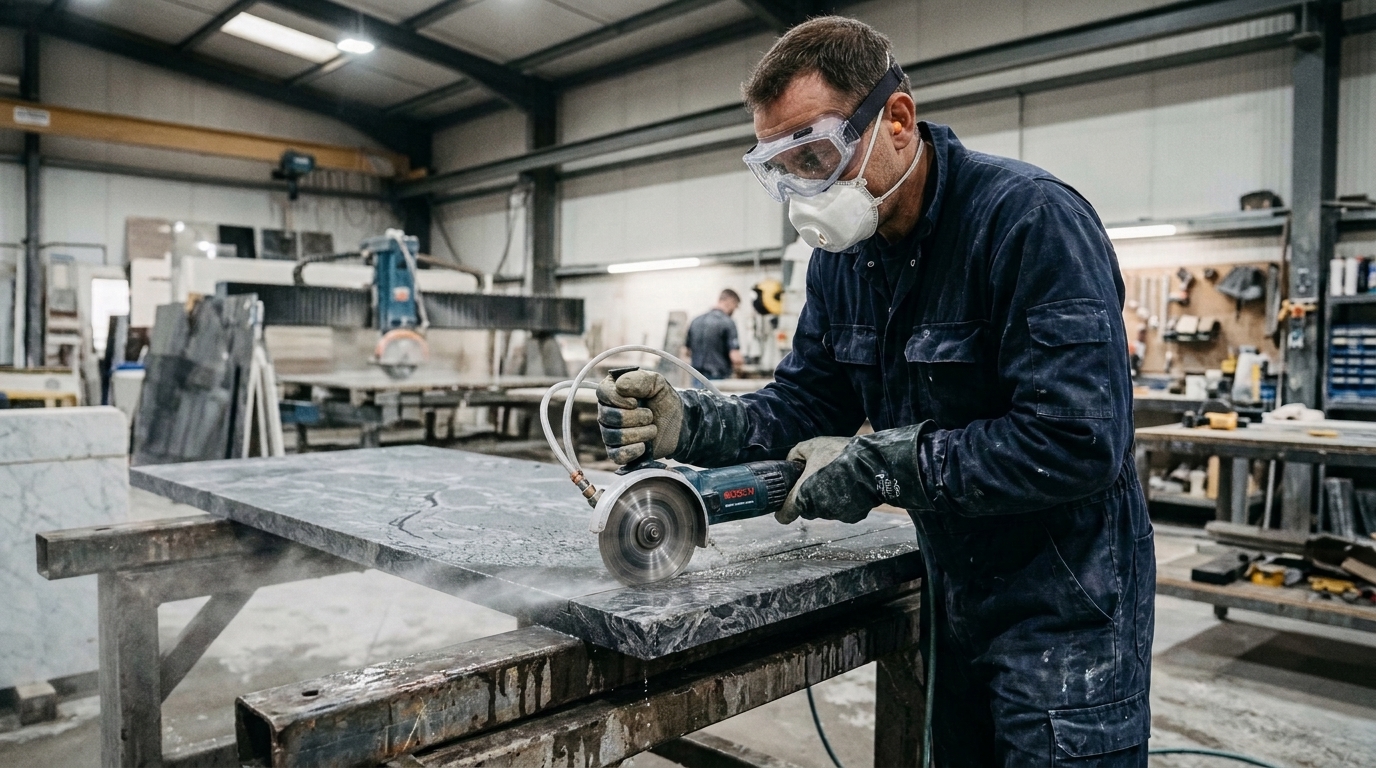
Vital sectors of the national economy — with a strong presence in the District of Leiria and the Central and Northern regions — such as the ceramic industry (tableware, flooring, porcelain), natural stone and quartz agglomerate processing, the mould-making industry, foundry, and civil construction deal daily with the cutting, grinding, polishing, and demoulding of materials with a high free silica fraction.
Prolonged inhalation of these microscopic particles (frequently under 5 micrometres in diameter, invisible to the naked eye) causes silicosis — a chronic, irreversible, and potentially fatal lung disease — as well as chronic obstructive pulmonary disease (COPD) and lung cancer.
1. Legal Framework and ACT Inspections in Portugal
With the transposition of European Directive (UE) 2017/2398 and the reinforcement of Portuguese labor regulations, crystalline silica dust generated by work processes is now expressly classified as a carcinogen.
- Occupational Exposure Limit (OEL): The strict legal limit in Portugal is 0.05 mg/m³ (measured as a respirable fraction weighted for an 8-hour shift).
- Priority of Protection Measures (Hierarchy of Control): The Authority for Working Conditions (ACT) requires employers to prove:
- Control at the source (wet cutting and localized dust extraction with HEPA filters).
- Forced general ventilation of industrial halls.
- Mandatory supply of high-efficiency individual Respiratory Protective Equipment (RPE) whenever residual levels cannot be reduced to zero.
2. What Level of Respiratory Protection is Required? (FFP2 vs. FFP3)
One of the most common and dangerous mistakes found in safety audits is the provision of generic FFP1 or surgical disposable masks for operations involving mineral dust. These masks do not offer retention for ultrafine quartz particles.
A. FFP3 Disposable Masks (EN 149 Standard)
For dry cutting operations, ceramic piece demoulding, mixing powdered slips, or stone sanding:
- Only the FFP3 class (EN 149 Standard) offers the necessary retention of 99% of airborne particles, with a Nominal Protection Factor (NPF) of 50.
- The use of masks with a low-resistance exhalation valve is recommended to reduce heat and moisture inside the respirator during demanding shifts.
- Pay attention to markings: NR (non-reusable, limited to 1 8-hour shift) or R (reusable, with a washable sealing ring).
B. Reusable Half-Masks with P3 Filters (EN 140 and EN 143 Standards)
For workers with continuous daily exposure exceeding 4 hours:
- The best economic and ergonomic solution is the adoption of silicone or thermoplastic elastomer half-masks with replaceable P3 mechanical filters.
- Silicone guarantees a better facial seal (Fit Factor), reduces the risk of contact dermatitis, and ensures a lower operational cost per workday compared to daily disposable masks.
3. The Critical Factor: Facial Seal (Fit Test) and Beards
No FFP3 respirator protects if there are air leaks around the edges. Silica dust follows the path of least resistance: if a microscopic gap exists between the seal and the face, the worker inhales contaminated air that bypasses the filter.
- Facial Hair and Beards: A 2 or 3-day beard reduces the filtration efficiency of an FFP3 mask from 99% to less than 60%. For workers with beards for personal reasons, the only legally compliant solution is Powered Air-Purifying Respirators (PAPR) with an integral hood or ventilated helmet (EN 12941 Standard).
- Training and Record-Keeping: The company is required by law to provide training on donning, fitting, and positive/negative pressure testing to operators before starting tasks.
4. Workwear and Cleaning: Preventing Cross-Contamination
Silica dust settles on work clothing and can be reinhaled when the worker takes off their uniform or shakes it out in the locker room.
- Absolute Ban on Compressed Air: It is strictly forbidden to use compressed air guns to clean dust from workers' uniforms. This practice aerosolizes dense clouds of microscopic silica directly into the breathing zone.
- High-Density Clothing: Use of Type 5/6 disposable coveralls (EN ISO 13982-1 Standard) for occasional kiln and filter cleaning tasks, or workwear in tightly woven mixed twill fabric laundered by the company in a closed industrial circuit.
How JCR Supports Your Factory's Compliance
J C R, Lda. provides integrated solutions for mitigating silica risk across the ceramic and mould-making industries:
- Scheduled supply of FFP3 respirators and P3 filters from world-renowned brands (3M, Moldex, Honeywell).
- Delivery documentation with legal compliance for ACT inspections.
- Support in selecting safety footwear and washable workwear.
Consult our specialized occupational health and safety advisors:
- 📞 +351 244 111 200 | 📧 webstore@jcr.pt | 🌐 jcr.pt