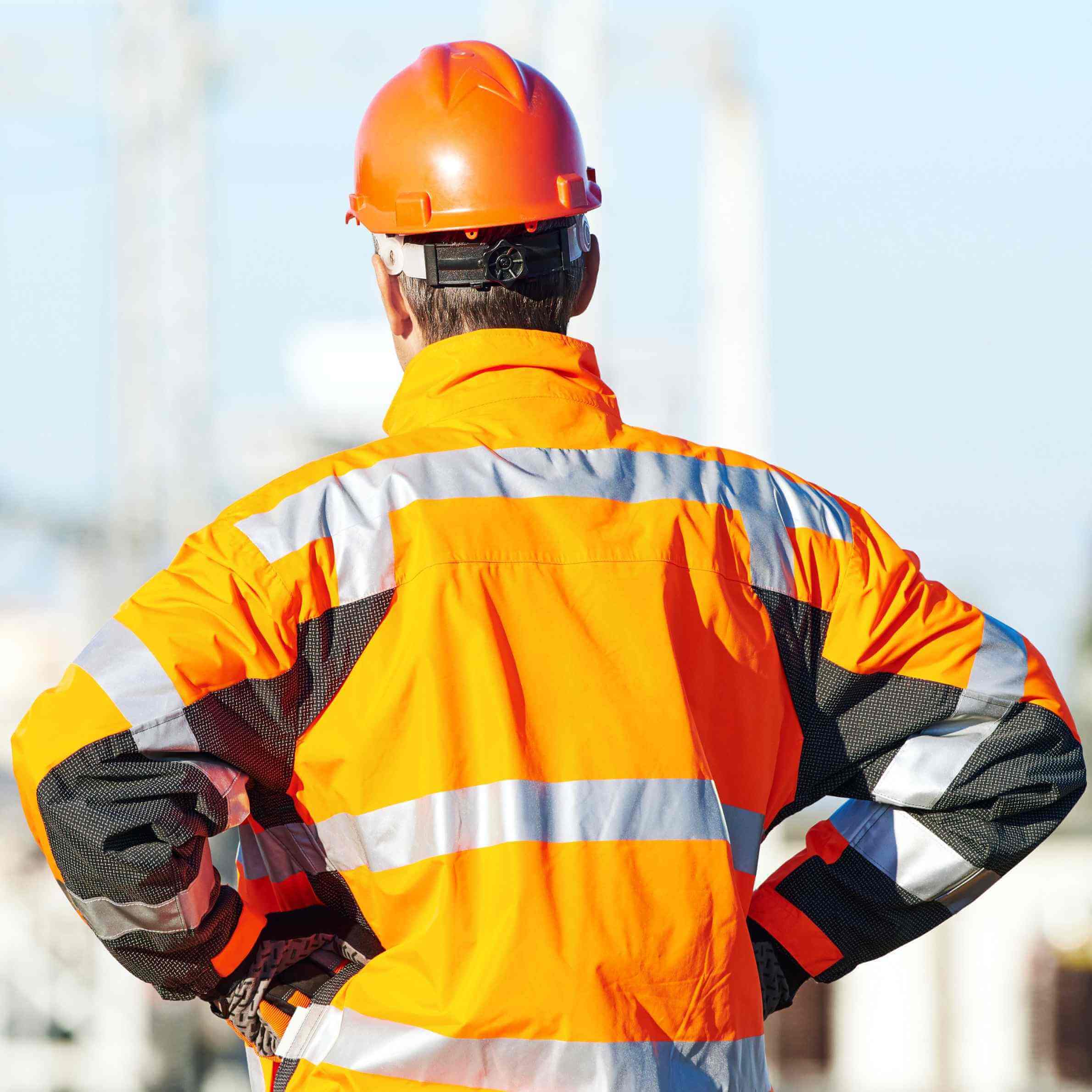
The Critical Function of High Visibility in Preventing Run-over Accidents
Being run over by moving vehicles and machinery (dump trucks, backhoes, forklifts, and passenger cars) constitutes one of the most frequent and severe occurrences in public works, ports, logistics platforms, and emergency operations.
High-visibility clothing is not merely a corporate identification element; it is a Category II Personal Protective Equipment (PPE) certified according to the harmonized European standard EN ISO 20471:2013+A1:2016 (High-visibility clothing — Test methods and requirements), which replaced the former EN 471 standard.
Its mission is to make the operator visually perceptible from any viewing angle (360°), whether during the day under intense sunlight or at night illuminated by vehicle headlights.
In this guide prepared by our in-house manufacturing technical workshop ANCORA / JCR, we detail the requirements of each protection class, the legally covered sectors, and the most frequent errors in maintaining these garments.
1. How Protection Works: The Two Mandatory Materials
To comply with the EN ISO 20471 standard, workwear obligatorily combines two materials with distinct optical behaviors:
1. Fluorescent Background Material (Daytime Visibility)
- Fabric with special pigments capable of absorbing invisible ultraviolet radiation and reflecting it as visible light.
- Ensures that the operator stands out sharply against natural or industrial backgrounds on cloudy days, at dawn, at dusk, and in fog.
- The three approved normative colors:
- Fluorescent Yellow: The color with the highest luminance perceptible to the human eye; standard in construction and road works.
- Fluorescent Orange: High contrast in rural, forestry, and railway areas (widely adopted by the railway sector of Infraestruturas de Portugal).
- Fluorescent Red: Frequently used in ambulances, rescue, and civil protection.
2. Retroreflective Material (Night Visibility Tapes)
- Tapes with high-refractive-index glass micro-beads or micro-prisms that return light directly back toward the emitting source (a vehicle's headlights), illuminating the human profile in total darkness.
- They must encircle the torso, arms, or legs to outline the human shape in motion.
2. The Three Protection Classes of the EN ISO 20471 Standard
The classification of a garment (or set) depends on the minimum visible surface area (in square meters) of each material:
| EN ISO 20471 Class | Minimum Fluorescent Area | Minimum Retroreflective Area | Risk Level & Road Speed | Typical Garment Examples |
|---|---|---|---|---|
| Class 1 | 0.14 m² | 0.10 m² | Low Risk: Work on roads with passive traffic below 30 km/h and no direct contact with public traffic. | Waist trousers, simple zip vests with thin tapes. |
| Class 2 | 0.50 m² | 0.13 m² | Medium Risk: Municipal roads, national roads with speeds up to 60 km/h, loading docks, construction yards, and port operations. | Classic reflective vests, t-shirts, polos, high-visibility cargo shorts. |
| Class 3 | 0.80 m² | 0.20 m² | High Risk: Highways, expressways (traffic exceeding 60 km/h), nighttime work on the roadway, and airports. | Long-sleeve jackets and parkas with tapes on the arms and torso, full coveralls. |
The Combined Sets Rule
The EN ISO 20471 standard allows achieving a higher class by combining two certified individual garments. For example:
- A Class 2 shirt combined with Class 2 trousers can constitute a certified Class 3 set, provided the combined area meets the 0.80 m² of fluorescent fabric and 0.20 m² of retroreflective tapes.
3. Who is Legally Obliged to Use High-Visibility Workwear in Portugal?
Portuguese labor legislation and the Highway Code (Código da Estrada) mandate the use of high-visibility clothing in the following contexts:
- Workers on Public Roads (Construction and Road Maintenance): Mandatory Class 2 minimum; on highways and main routes (IP/IC), Class 3 is required (normally a jacket or trousers + jacket).
- Waste Collection and Urban Cleaning Operators: Class 2 or 3 during nighttime operations or on the roadway.
- Logistics Platforms and Loading Docks with Forklifts: Mixed pedestrian and forklift traffic requires Class 2 vests or polos.
- Port and Airport Workers: Strict international safety regulations on the apron and docks.
- Pre-Hospital Emergency, Firefighters, and Civil Protection: Interventions in traffic accidents always require high-tenacity Class 3 clothing.
4. Critical Maintenance Care: The End of Life for Tapes
One of the most serious errors observed in workwear fleets is the prolonged use of vests and jackets whose tapes have lost their retroreflective properties:
- The Wash Limit: The garment label always indicates the maximum number of approved washing cycles (usually 25 or 50 washes). Exceeding this limit causes the glass micro-beads to disintegrate, and the vest stops shining in the dark.
- Washes with Fabric Softeners and Bleach: Categorically prohibited. They destroy the fluorescent chemical coating of the polyester.
- Grease, Dust, and Oil: A fluorescent workwear garment impregnated with construction grease loses the minimum area required by law (for example, dropping below the 0.50 m² of Class 2) and becomes non-compliant.
5. Customization and Logos in High Visibility: Watch Out for the Minimum Area!
When printing your company logo on a high-visibility garment, there are strict rules to follow:
[!CAUTION] Risk of Loss of Certification: If you print a giant logo on the back of a Class 2 vest, the printing ink covers the fluorescent fabric, reducing its useful area below the regulatory 0.50 m². The vest automatically loses its Class 2 CE certification before ACT (Portuguese Authority for Working Conditions)!
At the ANCORA / JCR customization workshop, our designers calculate the maximum printing or embroidery area on the back and chest, ensuring your brand's corporate image stands out without violating the minimum safety areas of the EN ISO 20471 standard.
Need Certified High-Visibility Workwear with Your Company Logo?
JCR manufactures and distributes Class 1, 2, and 3 high-visibility clothing in full compliance with the European standard, featuring ergonomic cuts and breathable fabrics:
- Manufacturing and Customization: +351 244 111 200 | webstore@jcr.pt
- Explore the range: JCR High-Visibility Workwear