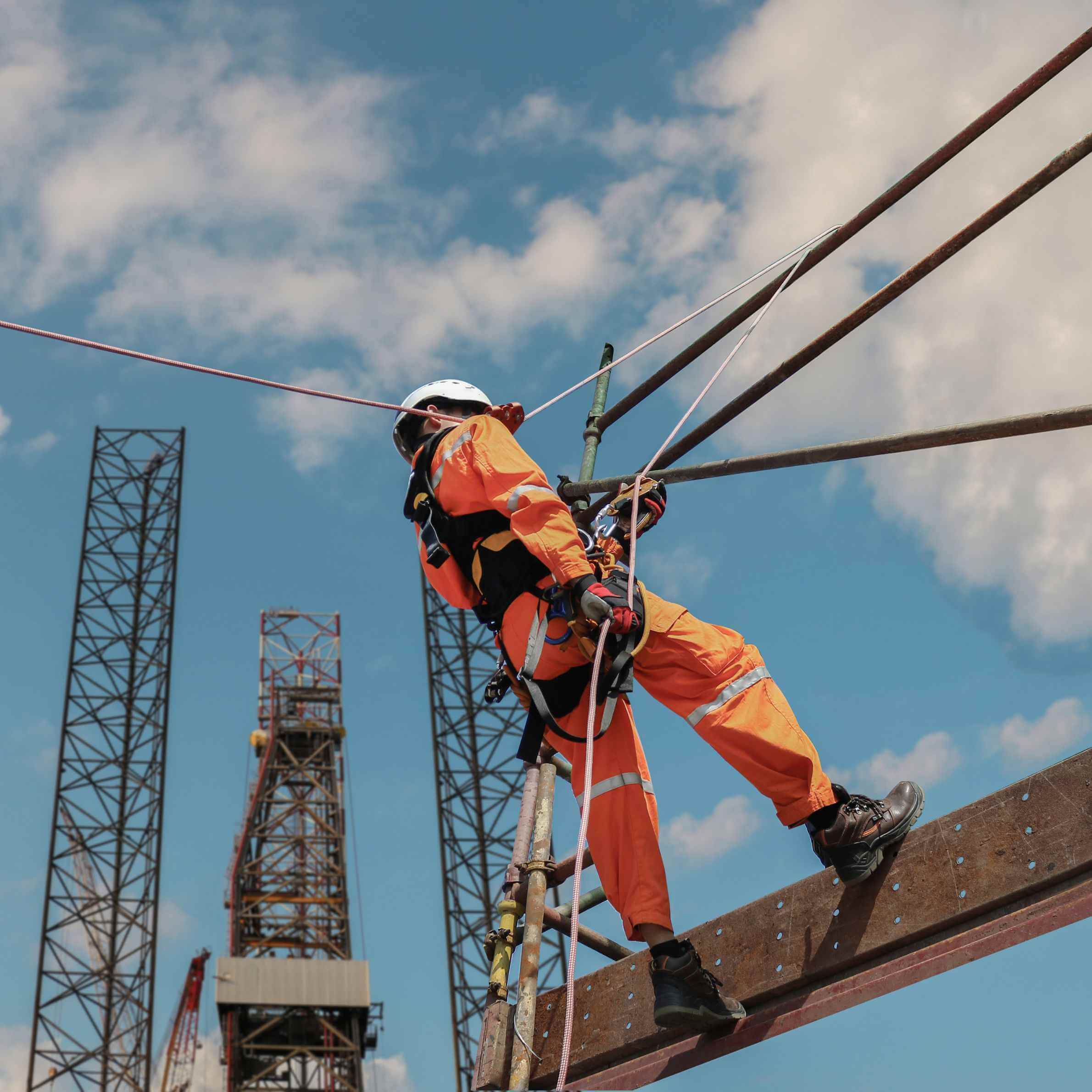
Legal Liability in Fall Protection Equipment Management
Work at height continues to be the leading cause of fatal workplace accidents and permanent disabilities in Portugal. National legislation — namely Decree-Law no. 50/2005 (Minimum safety and health requirements for the use of work equipment) and Law no. 102/2009 — clearly stipulates that the employer is criminally and civilly liable for providing, maintaining in perfect working condition, and periodically inspecting all Personal Protective Equipment (PPE) against falls from height.
However, many site supervisors and maintenance managers frequently ask the same critical question: "What is the actual lifespan of a safety harness, and who can certify its inspection?".
The answer does not rely solely on the user's opinion. It is strictly regulated by the European standard EN 365:2004 (General requirements for instructions for use, maintenance, periodic examination, repair, marking, and packaging) and by the technical datasheets of leading manufacturers such as Irudek and 3M Protecta.
1. Useful Life vs. Shelf Life: How to Calculate Years of Use?
When analyzing the indelible label of a harness certified according to EN 361, two fundamental dates stand out:
- Manufacturing Date: The moment the equipment left the certified production line.
- First Use Date: The date the harness was removed from its original sealed packaging and issued to the operator (must be recorded in the respective Equipment Control Sheet).
What is the Maximum Permitted Duration?
- Storage Life (Shelf Life): Most manufacturers allow up to 2 to 5 years of storage, provided it is kept in its original packaging, in a dry, dark place (protected from solar UV rays) and away from chemical vapors or hydrocarbons.
- Service Life: From the moment of first use, the maximum service life is typically 5 to 10 years for textile components (polyester and polyamide webbing, structural stitching) and up to 10 years or unlimited for purely metallic components (steel carabiners, D-rings), strictly subject to passing all periodic examinations.
[!CAUTION] The Golden Rule of Fall Arrest: Any harness, lanyard, lifeline, or self-retracting lifeline that has sustained a real fall by a worker must be immediately removed from service and destroyed, even if it has only been in use for a month and visually appears intact. The irreversible molecular stretching of the textile fibers and the plastic deformation of the rings cancel out their capacity to absorb a second impact.
2. Mandatory Inspection under Standard EN 365: Who and When?
Standard EN 365 establishes three complementary levels of verification that must be complied with without exception:
Level 1: Daily Pre-Use Check (By the Operator)
Before putting on the harness for each work shift, the specifically trained worker must visually and tactically inspect the equipment:
- Webbing free of cuts, fraying, welding burns, or contact with chemicals.
- Contrasting-colored safety stitches intact and free of loose threads.
- Adjustment buckles and quick-release fasteners engaging and locking firmly with no abnormal play.
Level 2: Mandatory Annual Periodic Examination (By a "Competent Person")
Every 12 months (maximum), all Category III fall protection PPE must undergo a thorough inspection carried out by a Competent Person.
Who is a Competent Person according to EN 365? It is a professional who has received technical training certified by the manufacturer (или accredited training body), capable of identifying microscopic defects, chemical degradation, internal corrosion, and material fatigue, with formal authority to sign off on approval or determine the immediate scrapping of the equipment.
Level 3: Extraordinary Verification
Mandatory whenever an exceptional event occurs: extreme storm with falling materials on the equipment, contact with acids, projection of incandescent sparks, or suspicion of overloading.
3. Technical Inspection Checklist: What Does the Specialist Technician Evaluate?
During the annual EN 365 compliance inspection, JCR follows a strict verification protocol divided into four blocks:
1. TRACEABILITY & LEGAL MARKING
   ├─ Harness label legible and intact
   ├─ CE marking with the 4 digits of the Notified Body (e.g., CE 0123)
   ├─ Individual serial number and batch identifiable
   └─ Reference standard indicated (EN 361 / EN 358 / EN 813)

2. TEXTILE COMPONENTS (Webbing, Pads, Stitching)
   ├─ Absence of transverse and longitudinal cuts on the webbing
   ├─ Absence of rigidity, glazing, or discoloration due to UV exposure
   ├─ Fall indicators (integrated overload seams): INTACT
   └─ High-tenacity structural stitching free of knots or ruptures

3. METALLIC COMPONENTS (Buckles, Dorsal and Sternal Rings)
   ├─ Free from cracks, plastic deformations, or sharp burrs
   ├─ Absence of deep corrosion or salt spray oxidation
   └─ Flawless operation of automatic latches and return springs

4. DOCUMENTATION AND RECORD-KEEPING
   ├─ Completion of the Individual Tracking Sheet
   ├─ Issuance of the Annual Inspection Certificate
   └─ Application of a physical inspection label valid until the following year
4. Documentary Records: What ACT Requires During an Inspection
In the event of an inspection by the Authority for Working Conditions (ACT) or an expert assessment following an accident, the company must immediately present the Equipment Control Sheet for each harness in use.
This dossier must compulsorily contain:
- Identification of the manufacturer, model, and serial number.
- Purchase date and first use date.
- Name of the worker to whom the harness is nominally assigned.
- Chronological history of annual inspections with date, identification, and signature of the Competent Person.
- Clear evaluation result: Approved for Service or Rejected / Scrapped.
[!WARNING] The absence of documentary records for the annual inspection of fall protection equipment constitutes a very serious administrative offense under Law no. 102/2009, punishable by severe fines and potential immediate suspension of work on the site.
5. How to Implement a Control Program in Your Company
Managing dozens or hundreds of harnesses, energy-absorbing lanyards, temporary lifelines, and self-retracting lifelines can become chaotic without a centralized control system.
It is recommended to:
- Internal Numbering: Identify each harness with an indelible internal inventory code associated with the factory serial number.
- Use JCR's Lifespan Tool: We provide the PPE Lifespan and Fleet Control Calculator on the JCR platform to automatically alert you to the inspection deadlines for your teams.
- Contract Periodic Inspections to Qualified Entities: Entrust the examination of your equipment to technicians with official training from top-tier manufacturers.
Do Your Harnesses Have Overdue Inspections or Do You Need to Renew Your Fall Protection Line?
The height safety specialists at JCR perform inspection, maintenance, and supply of complete fall arrest systems certified by standards EN 361, EN 358, and EN 360:
- Direct contacts: +351 244 111 200 | webstore@jcr.pt
- Explore the complete range: JCR Fall Arrest Systems and Harnesses